Introduction:
Why Labour Protection is Fundamental to a Sustainable Blue Economy
The growing global focus on World Environment Day, World Oceans Day and the Day of the Seafarer increasingly reflects a broader recognition that the sustainability of the blue economy cannot be measured solely through environmental protection, marine conservation or climate resilience. A truly sustainable blue economy also depends upon the treatment, protection and welfare of the workers whose labour sustains maritime trade, fisheries, tourism and coastal economies. Seafarers, fishers and coastal tourism workers remain among the most economically essential yet legally vulnerable labour groups globally. While international maritime conventions have significantly advanced labour protections over the past two decades, implementation gaps, regulatory fragmentation and weak enforcement continue to expose maritime workers to unsafe conditions, labour exploitation, inadequate social protections and occupational hazards. For Caribbean states pursuing blue economy growth strategies, aligning national labour frameworks with International Labour Organization (ILO) maritime conventions is no longer optional, it is essential for economic resilience, international credibility and sustainable maritime development.
Gender Mapping Exercise
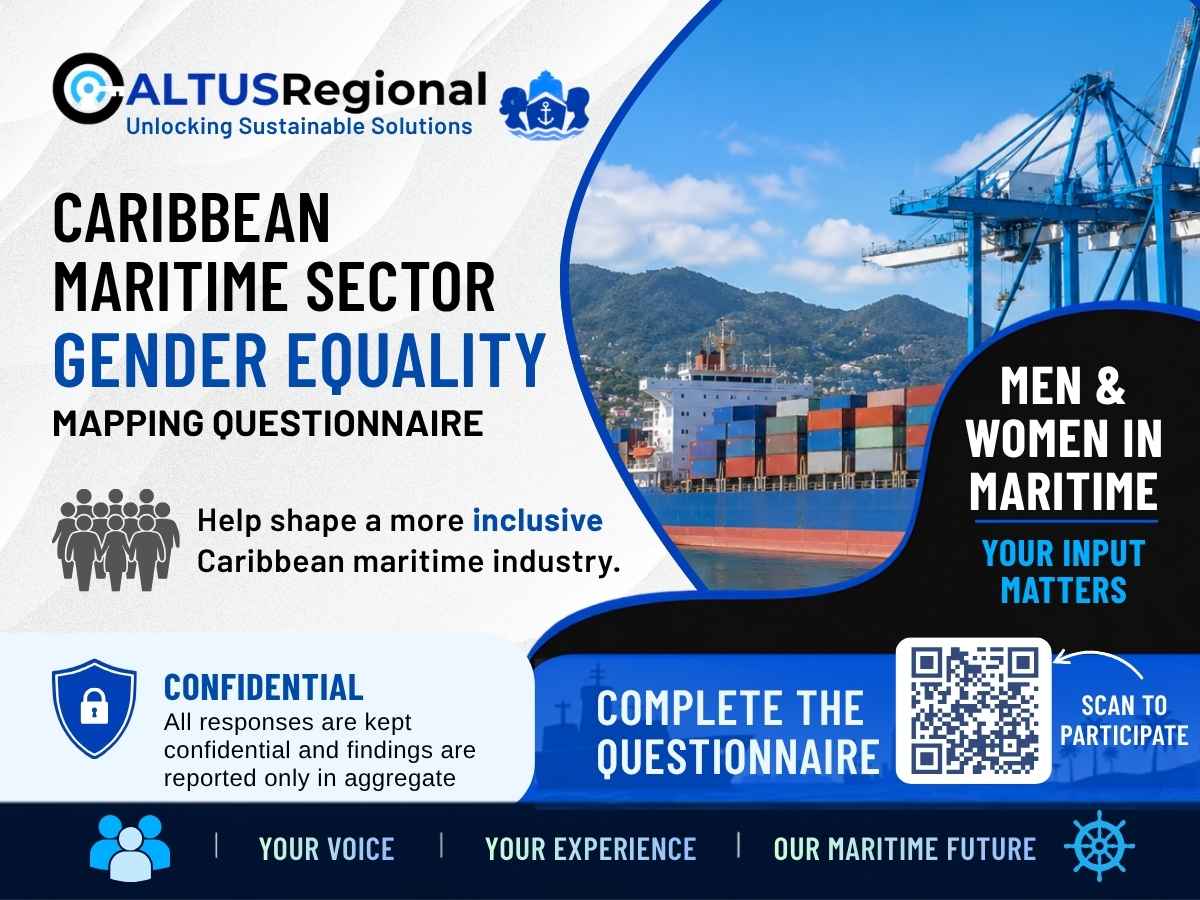
Altus Regional is conducting a regional Gender Equality Mapping Exercise to understand how Caribbean maritime institutions are progressing from policy commitments to real implementation. The mapping exercise is designed to assess whether institutions possess the policies and systems required to support gender‑equality implementation as part of their operational effectiveness. Your participation will help build the evidence base needed to enhance gender‑responsive governance across the Caribbean maritime sector.
Respond to the Questionnaire
The Maritime Labour Convention:
Establishing a Global Framework for Decent Work at Sea
The global economy remains fundamentally dependent on maritime labour. Approximately 90% of global trade is transported by sea, placing seafarers at the centre of international commerce and supply chain continuity. Yet despite this dependence, maritime labour historically operated within fragmented legal frameworks characterised by inconsistent protections, weak enforcement and significant jurisdictional complexity. The adoption of the International Labour Organization’s Maritime Labour Convention, 2006 (MLC, 2006) represented a major turning point in maritime labour governance. Frequently referred to as the “Seafarers’ Bill of Rights,” the Convention consolidated and modernised dozens of earlier maritime labour instruments into a single enforceable framework establishing minimum global standards for seafarers’ working and living conditions.
The MLC established minimum requirements relating to wages, hours of work and rest, accommodation standards, occupational safety, medical care, repatriation rights, food quality, welfare protections and social security coverage. Critically, it also introduced compliance and enforcement mechanisms linked to flag state obligations and port state inspections, significantly strengthening accountability within international shipping. The Convention has since achieved widespread ratification, covering the overwhelming majority of global shipping tonnage. The significance of the Convention extends beyond labour rights alone. Increasingly, labour protections are recognised as integral to maritime safety, operational resilience and sustainable shipping governance. Fatigue, poor accommodation, inadequate medical care and unsafe working conditions are now widely understood to increase accident risk, impair operational performance and undermine supply chain stability.
Closing the Protection Gap for Fishers
However, while protections for seafarers have strengthened under the MLC framework, substantial labour protection gaps remain within other sectors of the blue economy, particularly fisheries and coastal tourism. Fishers remain among the most dangerous and least regulated occupational groups globally. The ILO Work in Fishing Convention, 2007 (Convention No. 188) was specifically adopted to address this gap by establishing minimum standards relating to occupational safety, medical care, rest periods, accommodation, social security and written work agreements for commercial fishers. The Convention recognises that fishing work presents distinct hazards, including vessel instability, extreme weather exposure, equipment accidents, fatigue, isolation and limited access to emergency medical care. Yet despite these risks, ratification and implementation levels for the Convention remain significantly lower than for the Maritime Labour Convention.
This disparity is particularly relevant for the Caribbean, where fisheries remain economically and culturally significant while regulatory oversight capacity is often constrained. Small-scale fishers frequently operate outside formal labour systems without adequate insurance, occupational health protections or social security coverage. Informal employment arrangements, aging vessels, insufficient safety equipment and limited regulatory inspections compound these vulnerabilities. Climate change further intensifies occupational risks through increasingly unpredictable weather patterns, stronger storms and changing fish migration patterns, forcing fishers into more hazardous operating conditions. In this context, labour standards cannot be separated from broader climate resilience and marine governance discussions.
Strengthening Labour Protections for Coastal Tourism Workers
Coastal tourism workers similarly occupy a complex and often overlooked position within the blue economy. Cruise terminals, waterfront tourism developments, marine excursion services, recreational boating operations, dive tourism and hospitality services generate substantial employment throughout the Caribbean. Yet many workers within these sectors experience seasonal employment insecurity, inadequate occupational health protections, exposure to extreme heat, unsafe transport conditions and weak labour enforcement. Cruise ship workers, in particular, occupy a hybrid legal environment where labour protections depend upon the interaction of flag state law, employment contracts, international conventions and port state oversight. Although cruise ship crew are generally protected under the Maritime Labour Convention, practical enforcement challenges remain significant, particularly regarding working hours, fatigue, mental health protections and access to remedies for workplace grievances.
Lessons from the COVID-19 Pandemic:
Building More Resilient Maritime Labour Systems
The COVID-19 pandemic exposed many of these structural vulnerabilities within maritime labour systems. During the global crew change crisis, hundreds of thousands of seafarers remained stranded aboard vessels for extended periods due to border closures and travel restrictions, often beyond maximum service periods permitted under international standards. The crisis highlighted how quickly labour protections can erode during emergencies despite existing legal frameworks. It also demonstrated the need for stronger coordination between labour law, immigration systems, maritime regulation and public health governance. The humanitarian and operational consequences of the crisis reinforced the broader principle that maritime workers are essential workers whose protections are directly linked to global economic resilience.
Policy Priorities for Caribbean Governments
For Caribbean governments pursuing blue economy strategies, these developments create important policy implications. Sustainable ocean governance cannot focus exclusively on marine conservation, port development, renewable energy or tourism investment while neglecting labour governance. Blue economy legislation and policy frameworks must incorporate enforceable labour standards as a core component of maritime sustainability. This requires domestic legal alignment with international labour conventions, but also meaningful implementation through inspection systems, enforcement mechanisms, labour tribunals, occupational safety standards and accessible grievance procedures.
First, Caribbean states should strengthen ratification and implementation of relevant ILO maritime conventions, including the Maritime Labour Convention and the Work in Fishing Convention. Ratification alone is insufficient if domestic legislation does not fully incorporate inspection obligations, employer liabilities, occupational safety requirements and worker protections. Labour ministries, maritime administrations and port authorities must operate within coordinated regulatory frameworks rather than fragmented institutional silos.
Modernising Occupational Safety, Social Protection and Worker Welfare
Second, occupational safety and health standards for maritime and coastal workers should be modernised to address emerging climate and environmental risks. Heat stress, hurricane exposure, coastal flooding, extreme weather events and marine pollution increasingly affect worker safety across ports, fisheries and tourism operations. Labour regulation must therefore evolve beyond traditional workplace safety concepts toward climate-responsive occupational protection frameworks.
Third, governments should strengthen social protection systems for maritime workers, particularly those operating within informal or seasonal sectors. Fishers and coastal tourism workers frequently lack adequate insurance, income protection, pension coverage or medical support despite operating in high-risk industries. Expanding access to social protection is not merely a labour issue but a resilience and economic stability issue for coastal communities.
Fourth, stronger legal protections are needed regarding mental health, harassment, discrimination and welfare support for maritime workers. The maritime sector has historically prioritised physical safety while under-addressing psychosocial risks, including fatigue, isolation, harassment and mental health pressures. Recent international discussions between the International Labour Organization and the International Maritime Organization increasingly recognise bullying, harassment and mental health as major maritime labour governance concerns requiring stronger regulatory responses.
Integrating Labour Standards into Blue Economy Governance
The broader lesson emerging from World Environment Day, World Oceans Day and the Day of the Seafarer is that environmental sustainability and labour sustainability are inseparable within the blue economy. Ports cannot function without seafarers. Fisheries cannot operate without fishers. Tourism economies cannot thrive without coastal workers. A blue economy built on unsafe, insecure or exploitative labour conditions is neither sustainable nor resilient. The future of maritime governance therefore requires an integrated approach in which labour standards, environmental protection, climate resilience and economic development are treated as interconnected pillars of ocean sustainability rather than separate policy domains.
Conclusion:
Protecting Maritime Workers as a Pillar of a Sustainable Blue Economy
For Caribbean states, the policy direction is increasingly clear. Blue economy strategies must incorporate enforceable labour protections grounded in international maritime conventions, climate-responsive occupational safety systems, stronger social protection frameworks and meaningful regulatory enforcement capacity. The transition toward sustainable ocean economies cannot be achieved solely through infrastructure investment or environmental policy; it must also protect the workers whose labour sustains the maritime economy itself.
Request Advisory Support
If your organisation is working to strengthen its gender‑equality policies and implementation systems, Altus Regional can help. Contact us to learn how our policy development, training, and institutional support services can advance your goals.
International Labour Organization. (2006). Maritime Labour Convention, 2006 (MLC, 2006). International Labour Organization.
International Labour Organization. (2007). Work in Fishing Convention, 2007 (No. 188). International Labour Organization.
International Labour Organization. (2017). A growing recognition of the ocean as a workplace. International Labour Organization.
International Labour Organization & International Maritime Organization. (2026). Maritime Labour Convention at 20: Reaffirming commitment to decent work at sea.
International Transport Workers’ Federation. (2025). Maritime Labour Convention: Seafarers’ rights and protections.
International Labour Office. (2025). Contribution to the report of the Secretary-General on oceans and the law of the sea. United Nations.
Bahamas Maritime Authority. (2025). Maritime Labour Convention (MLC) and International Labour Organization standards.
Altus Regional is a multidisciplinary consulting firm delivering integrated advisory, technical, modernization, training, capacity‑building, and project‑delivery services across a wide range of sectors.
Creative design solutions that help organisations of all sizes communicate with clarity, personality and purpose through thoughtful visual and digital design.
Altus Regional provides technical services that support planning, delivery, and operational decision‑making across infrastructure, environmental systems, natural resources, and climate‑related initiatives.
Altus Regional delivers tailored marketing and communications solutions that strengthen institutional positioning and stakeholder trust across public, private, and regulated sectors.
Altus Regional works across sectors where governance, regulation, and operational complexity intersect, unlocking sustainable solutions specifically tailored to address the unique realities of the Caribbean.
Our service divisions reflect specialised capability aligned with specific sectors, addressing the distinct needs and challenges of the industries we serve.