Caribbean Maritime Sector Gender Equality Mapping 2026

Caribbean Maritime Sector Gender Equality Mapping 2026Altus Regional Launches Gender Equality Mapping Exercise

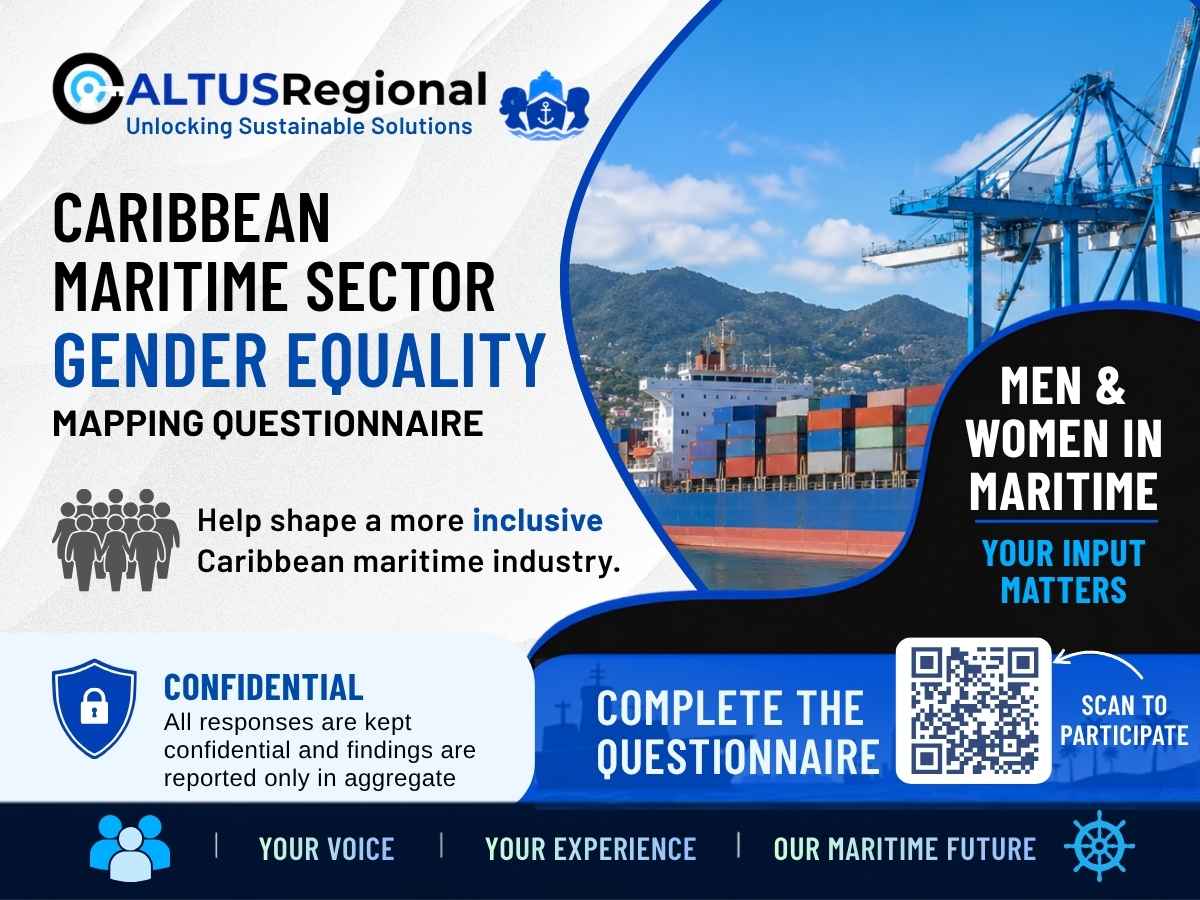
Altus Regional Consulting Solutions (Caribbean) Ltd. announces the launch of the Caribbean Maritime Sector Gender Equality Mapping 2026, a regional initiative designed to build the evidence base required to strengthen gender‑responsive governance across the maritime sector. This Mapping Exercise responds to the growing recognition that gender equality is not a peripheral social concern but a structural component of maritime excellence. It examines workforce composition, organisational practices, and institutional systems across ports, shipping companies, maritime administrations, ferry and water‑taxi operators, training institutions, and marine enforcement units. The initiative provides the first consolidated regional picture of how Caribbean maritime institutions are positioned to advance gender‑responsive practice.
 
Findings from the Mapping Exercise will directly inform the development of articles, guidance materials, and other knowledge products within the Policy to Practice series, grounding the framework in regional data and institutional realities.

Gender Mapping Exercise

Altus Regional is conducting a regional Gender Equality Mapping Exercise to understand how Caribbean maritime institutions are advancing gender equality. We invite maritime organisations across the Caribbean to contribute to this regional evidence‑building effort. Your participation ensures that toolkits, templates, and knowledge products developed through the Policy to Practice series reflect the realities of the sector. Complete the questionnaire and help shape the future of gender‑responsive maritime governance.

Complete the Gender Mapping Survey

Preliminary Insights As at 25 June 2026

Preliminary findings from the Caribbean Maritime Sector Gender Equality Mapping Exercise show that many maritime institutions have not yet developed the foundational systems that support gender equality. Internal reporting or grievance mechanisms are inconsistent or unclear, training on bias and harassment is limited, and welfare and behavioural safeguards are uneven. Few institutions have internal structures dedicated to gender equality, such as gender focal points, committees, or governance frameworks, leaving them without the internal architecture required to support gender‑responsive practice.

Preliminary findings further indicate that many maritime institutions do not collect gender‑disaggregated data. This early pattern points to a broader evidence gap in the sector, underscoring the importance of the Gender Equality Mapping Exercise, which will provide a consolidated evidence base of institutional readiness to advance gender equality in the maritime sector. 

Insight 1 — Gender Representation Across Roles As at 25 June 2026

Early responses indicate that women and men are distributed unevenly across maritime roles, with higher representation in administrative and training functions and lower representation in technical, operational, and seafaring positions. These initial patterns reflect the current gender composition of the responding organisations and will continue to evolve as more data are submitted.

Insight 2 — Policy and Institutional Frameworks As at 25 June 2026

Early responses indicate that many maritime institutions operate without a formal gender equality policy. Among those with a policy, respondents reported on whether key components are present, including review cycles, designated responsibility, tracking mechanisms, budget allocation, and whether the policy has contributed to observable changes in behaviour. These responses provide an early snapshot of how gender equality commitments are structured across institutions.

Insight 3 — Systems and Capacity for Implementation As at 25 June 2026

Respondents have begun reporting on the systems their organisations currently use to support gender equality, including training, reporting pathways, data collection, and monitoring mechanisms. Early results indicate few institutions maintain gender‑disaggregated workforce data or conduct regular assessments of equality outcomes.

Moving Towards Compliance Excellence

AltusComply

AltusRegional Compliance Tools & Resources

Read More

AltusLDP

AltusRegional Learning & Development Portal

Enter here

AltusInsights

AltusRegional Insights, Trends & Research Findings

Read More

AltusRegional Learning Development Portal AltusLDP Offerings

Developing Gender Equality Policies for the Caribbean Maritime Sector

This course guides maritime institutions through the process of designing a coherent, legally aligned, and operationally relevant gender equality policy. It introduces the essential components of a strong policy, the governance structures that support it, and the steps required to ensure organisational ownership and approval. Participants learn how to translate obligations and institutional realities into a structured policy framework that can be implemented across diverse maritime environments.

Read More

Implementing Gender Equality Policies Across the Maritime Sector

This course focuses on the systems, processes, and institutional mechanisms required to operationalise a gender equality policy. It examines reporting pathways, training and awareness programmes, monitoring and evaluation systems, and the organisational practices that sustain compliance and culture change. Participants learn how to embed policy commitments into daily operations, strengthen accountability, and build the internal capability needed for long‑term implementation.

Read More

Maritime Policy Implementation Using the Five-Step Maritime Policy Implementation Framework

This course introduces the Five‑Step Maritime Policy Implementation Framework and demonstrates how it can be applied to strengthen institutional performance across a range of policy areas. Participants explore the sequence of assessment, governance, integration, capacity building, and continuous improvement, gaining practical tools to move from policy statements to measurable operational practice. 

Read More

Caribbean Compliance

Our Areas of Focus Sectors We Serve

Altus Regional works across sectors where governance, regulation, and operational complexity intersect, unlocking sustainable solutions specifically tailored to address the unique realities of the Caribbean.

Upcoming Events Learning Events, Training & Capacity Building Initiatives, and Thought Leadership

Gain insights on industry trends, register for our upcoming webinars and workshops, and follow our thought leadership platforms.

Thought Leadership

Our Service Divisions

Our service divisions reflect specialised capability aligned with specific sectors, addressing the distinct needs and challenges of the industries we serve.


Unlocking Sustainable Solutions