

By: Natalie O. Sandiford, LLB, LLM, MSc, LEC, CAMS
Director, Research, Maritime & AML Governance
Advancing Gender Equality: A New Era for Maritime Excellence
Gender Mapping Exercise
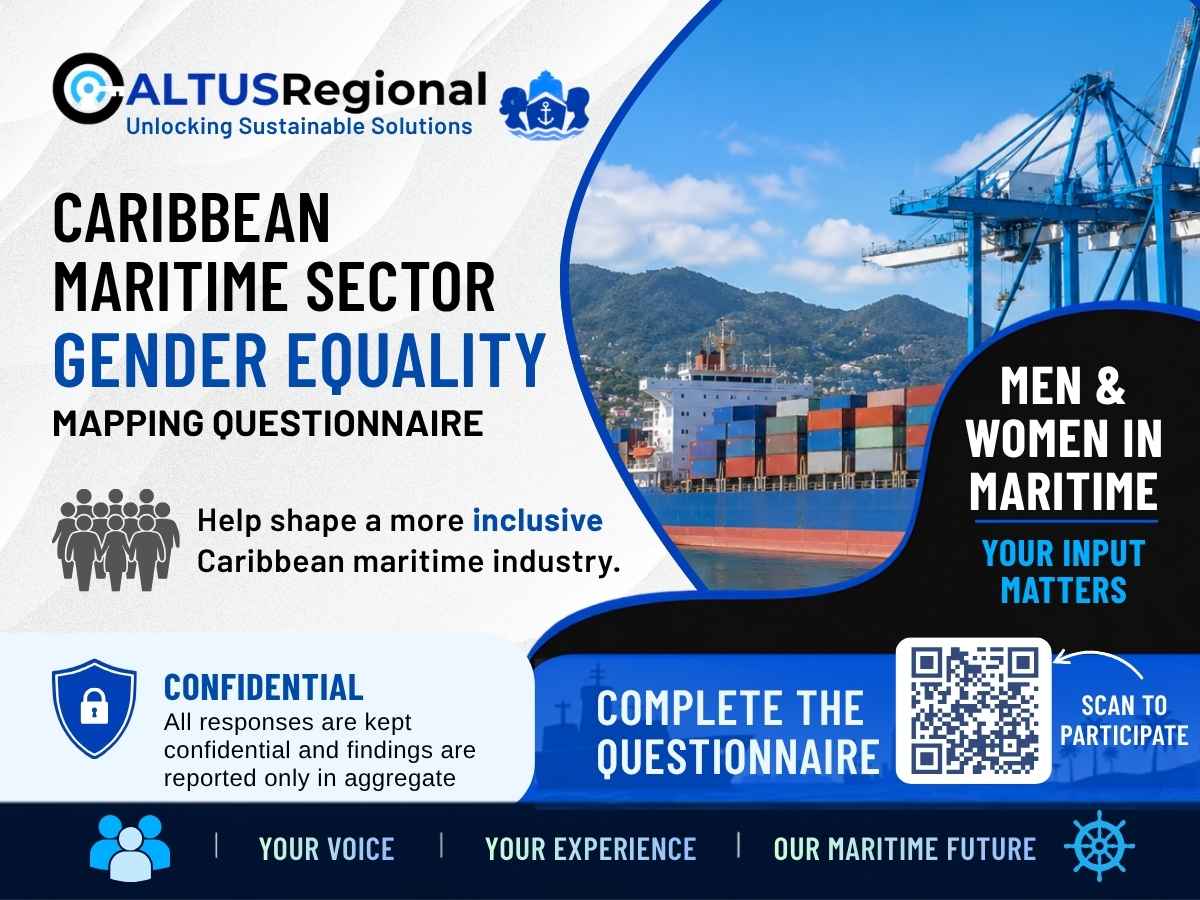
Altus Regional is conducting a regional Gender Equality Mapping Exercise to understand how Caribbean maritime institutions are advancing gender equality. The mapping exercise is designed to assess whether institutions possess the policies and systems required to support gender‑equality as part of their operational effectiveness. Your participation will help build the evidence base needed to enhance gender‑responsive governance across the Caribbean maritime sector.
Complete the Gender Mapping Survey
Gender Equality as a Pillar of Maritime Excellence
The International Framework: IMO, ILO, and Global Gender Equality Commitments
- Convention on the Elimination of all forms of Discrimination Against Women, 1979 (CEDAW 1979)
- Maritime Labour Convention, 2006 (MLC 2006)
- ILO Violence and Harassment Convention, 2019 (C190)
- Women in Maritime Programme, established by IMO Assembly Resolution A.1147(31)
The Convention on the Elimination of all forms of Discrimination Against Women (CEDAW) 1979, often described as the international bill of rights for women, required states to eliminate discrimination against women in all areas of public and private life, including employment, leadership, and participation in traditionally male‑dominated sectors. It calls for proactive measures to remove structural barriers, ensure equal access to opportunities, and create institutional environments where women can participate and lead on equal terms. While CEDAW is sector‑agnostic, it establishes the national policy foundations that shape gender‑responsive governance across all industries, including maritime.
The ILO Violence and Harassment Convention, 2019 (C190) set out the global standard for preventing and addressing violence and harassment in the world of work, including gender‑based violence. For maritime institutions, C190 provides a clear expectation that employers must adopt policies, systems, and procedures that ensure safe working environments for all workers. This includes risk assessments, reporting mechanisms, training, and accountability structures. The adoption of Recommendation R206 Concerning the Elimination of Harassment in the World of Work has provided a global framework for addressing violence and harassment. These ILO instruments reinforce that safety and dignity at work are integral to operational excellence, and that institutions cannot achieve high performance without addressing the conditions that undermine worker wellbeing.
Taken together, these instruments demonstrate a clear and sustained international commitment to advancing gender‑equality as an essential component of maritime excellence. However, the IMO has not yet developed a binding international convention on gender policy.
While international instruments codify clear global standards, their impact depends on national adoption, domestication, and enforcement. This distinction is critical:
- States sign and ratify international conventions.
- States domesticate international commitments and obligations into national law.
- Institutional action only becomes mandatory when national legal and regulatory frameworks so stipulate.
The Global Maritime Sector Context
The IMO–WISTA Women in Maritime Survey 2024 provides the most comprehensive and up‑to‑date global dataset on women’s participation in the maritime sector, revealing persistent structural inequalities across both public and private institutions. Key findings include:
⊗ Of the 211,750 active seafarers reported by surveyed companies, women account for just around 1% (2,117), with most female seafarers concentrated in cruise and passenger shipping rather than in cargo, offshore, or technical operations.
⊗ In the wider maritime industry, women represent only 16 per cent of the private‑sector workforce and 19 per cent of the workforce in national maritime administrations.
⊗ Representation declines sharply in technical, operational, and mid‑management roles, where women hold only 21 per cent of core maritime positions and 17 per cent of management posts.
⊗ 157 organisations reported having no gender‑equality policy in recruitment or promotion, underscoring the absence of institutional frameworks needed to support equitable workforce development.
The survey identifies several systemic barriers that continue to limit women’s access to and progression within maritime careers. These include gender stereotyping, workplace safety concerns, limited family‑friendly policies, and the ongoing gender pay gap. The report also highlights gaps in flexible working arrangements, insufficient pathways for young women entering STEM‑related maritime fields, and uneven representation of women in international maritime governance, with 24 Member States reporting no female delegates at IMO meetings.
These findings illustrate that the barriers facing women in the maritime sector are rooted in systems that have not yet evolved to support equitable participation. For the Caribbean, this global evidence reinforces the central point that meaningful progress depends on the advancement of gender equality. In a sector where women remain significantly under‑represented, leadership at the national level becomes essential for shaping consistent institutional practices across the sector.
Regional Leadership: WiMAC, WISTA, and the Caribbean’s Gender Equality Movement
Gender Equality Advancement Gaps in the Caribbean Maritime Sector
While many Caribbean States have endorsed broad gender equality commitments through national gender policies and ratification of international instruments such as CEDAW 1979, the Maritime Labour Convention, 2006 and the ILO Violence and Harassment Convention (C190), these frameworks rarely translate into sector‑specific direction for maritime institutions. As a result, maritime institutions across the region frequently operate without the national guidance, expectations, or standards needed to shape consistent gender‑responsive practice.
This absence of maritime‑specific direction is compounded by uneven institutional readiness across the region. Preliminary findings from the Caribbean Maritime Sector Gender Equality Mapping Exercise show that many maritime institutions have not yet developed the foundational systems that support gender equality. Internal reporting or grievance mechanisms are inconsistent or unclear, training on bias and harassment is limited, and welfare and behavioural safeguards are uneven. Few institutions have internal structures dedicated to gender equality, such as gender focal points, committees, or governance frameworks, leaving them without the internal architecture required to support gender‑responsive practice.
Finally, preliminary findings indicate that many maritime institutions do not collect gender‑disaggregated data. This early pattern points to a broader evidence gap in the sector, underscoring the importance of the Gender Equality Mapping Exercise, which will provide a consolidated evidence base of institutional readiness to advance gender equality in the maritime sector. Taken together, the preliminary findings of the Caribbean Maritime Sector Gender Equality Mapping Exercise confirm that the Caribbean maritime sector is still in the advancement stage.
These limitations are not unique to the Caribbean; they mirror global patterns identified in the IMO-WISTA Women in Maritime Survey 2024. However, they take on added significance in a region where women remain significantly under‑represented across seafaring, technical roles, port operations, and maritime administration leadership. In a sector with such low representation, national leadership becomes essential for setting expectations, providing guidance, and ensuring consistency.
Overall, this is the landscape within which the 2026 International Day for Women in Maritime theme “From Policy to Practice: Advancing Gender Equality for Maritime Excellence” must be understood- not as a call to implement what does not yet exist, but as an invitation to advance the foundations that will make implementation possible.
Advancing Gender Equality Caribbean Maritime Sector Perspective
The Future of Maritime Excellence Depends on the Advancement Gender Equality
A Practical Pathway Forward: Altus Regional’s Implementation Course
Request Advisory Support
If your organisation is working to strengthen its gender‑equality policies and implementation systems, Altus Regional can help. Contact us to learn how our policy development, training, and institutional support services can advance your goals.
Discover How We Can HelpInternational Maritime Organization (IMO)
International Maritime Organization. (2026). International Day for Women in Maritime 2026.
Retrieved from: https://www.imo.org/en/mediacentre/pressbriefings/pages/international-day-for-women-in-maritime-2026-id4wim-mainstreaming-gender-equality.aspx
International Maritime Organization. (2019). Preserving the legacy of the World Maritime Theme for 2019 and achieving a barrier‑free working environment for women in the maritime sector (Assembly Resolution A.1147(31)).
Retrieved from https://wwwcdn.imo.org/localresources/en/KnowledgeCentre/IndexofIMOResolutions/AssemblyDocuments/A.1147(31).pdf
International Maritime Organization. (n.d.). Women in Maritime Programme.
Retrieved from https://www.imo.org/en/ourwork/technicalcooperation/pages/womeninmaritime.aspx
International Labour Organization (ILO)
International Labour Organization. (2019). Violence and Harassment Convention, 2019 (No. 190).
Retrieved from https://normlex.ilo.org/dyn/nrmlx_en/f?p=NORMLEXPUB:12100:0::NO::P12100_INSTRUMENT_ID:3999810
International Labour Organization. (2006). Maritime Labour Convention, 2006 (MLC 2006).
Retrieved from https://www.ilo.org/international-labour-standards/maritime-labour-convention-2006
International Labour Organization. (2024). Beneath the surface: Analyzing the maritime workforce [Blog post].
Retrieved from https://ilostat.ilo.org/blog/beneath-the-surface-analyzing-the-maritime-workforce/
United Nations & UN Women
Office of the High Commissioner for Human Rights. (1979). Convention on the Elimination of All Forms of Discrimination Against Women (CEDAW).
Retrieved from https://www.ohchr.org/en/instruments-mechanisms/instruments/convention-elimination-all-forms-discrimination-against-women
UN Women. (2019). Violence and Harassment Recommendation, 2019 (No. 206).
Retrieved from https://shknowledgehub.unwomen.org/en/resources/violence-and-harassment-recommendation-2019-no-206
CARICOM
CARICOM Secretariat. (2023). CARICOM Gender Equality Strategy aims to fulfil vision of protection and economic empowerment of women, equitable access to education and healthcare for all.
Retrieved from https://caricom.org/caricom-gender-equality-strategy-aims-to-fulfil-vision-of-protection-and-economic-empowerment-of-women-equitable-access-to-education-and-healthcare-for-all/
WiMAC & WISTA
WiMAC Belize Chapter. (2025). Our Impact.
Retrieved from https://wimacbelizechapter.com/our-impact
WiMAC Barbados Chapter. (2025). Mobilizing Networks for Gender Equality [Workshop announcement].
Retrieved from https://altusregional.com/announcement/wimac-barbados-chapter-workshop-mobilizing-networks-for-gender-equality/
WISTA International. (2025). WISTA International.
Retrieved from https://wistainternational.com/
Altus Regional & Related Tools
Altus Regional Consulting Solutions. (2026). Regional Gender Equality Mapping Exercise – Caribbean Maritime Sector [Questionnaire].
Retrieved from https://forms.gle/NbN5867JDoNVier69
YouTube Webinar
WiMAC Barbados Chapter. (2025). Enhancing the Future of Maritime Safety [Video]. YouTube.
Retrieved from https://www.youtube.com/watch?v=23u1aUhZoE4&t
Sandiford, N. (2026). From Policy to Practice: Powering Maritime Excellence [World Maritime Theme].
Retrieved from https://altusregional.com/from-policy-to-practice-powering-maritime-excellence/
Our Services
Altus Regional is a multidisciplinary consulting firm delivering integrated advisory, technical, modernization, training, capacity‑building, and project‑delivery services across a wide range of sectors.
Research, Insights & Analytics
We deliver applied research and evidence‑based insights that help institutions resolve challenges and make informed decisions.
Regulatory Compliance
Regulatory Compliance services supporting regulated entities in meeting international standards and reporting obligations.
Market Entry Strategy
Structured market entry support helping international brands navigate the Caribbean’s multi‑jurisdictional frameworks with confidence.
Policy Development
We draft and develop policies, guidelines, rules, and standard operating procedures that translate mandates into practical directions.
Project Delivery
Remote or embedded consultant support providing structured coordination and oversight to ensure successful project execution.
Training & Capacity Building
Altus Regional delivers targeted training and capacity building aligned with sector requirements, regulatory frameworks, and operational needs.
Creative Design Solutions
Creative design solutions that help organisations of all sizes communicate with clarity, personality and purpose through thoughtful visual and digital design.
Legislative Drafting
Legislative drafting services supporting Caribbean Governments in updating and modernizing laws, regulations and statutory instruments.
Strategic Planning
Altus Regional provides strategic planning expertise that strengthens national, sectoral and organisational decision making.
Technical Services
Altus Regional provides technical services that support planning, delivery, and operational decision‑making across infrastructure, environmental systems, natural resources, and climate‑related initiatives.
Digital & Data Governance
We work alongside technical experts integrating laws, policies, and institutional mandates into digital and data‑driven solutions.
Marketing & Communications
Altus Regional delivers tailored marketing and communications solutions that strengthen institutional positioning and stakeholder trust across public, private, and regulated sectors.
Our Service Divisions
Our service divisions reflect specialised capability aligned with specific sectors, addressing the distinct needs and challenges of the industries we serve.