Structured Coordination for a High-Stakes Caribbean Port Transition Project
A practice‑based look at how Altus Regional supported the coordination of a high‑stakes Caribbean port transition, distilling the lessons learned, practical approaches, and governance practices that helped maintain alignment and operational continuity during a critical period.
From Policy to Practice: A Practical Framework for Maritime Policy Implementation
A practice‑driven framework for moving from policy intent to effective implementation across the maritime sector. This article introduces the Maritime Policy Implementation Framework, offering a structured approach for effectively moving from policy to practice in the maritime sector.

Marine Spatial Planning for Blue Economy Investment
This article explains how Marine Spatial Planning (MSP) is becoming a key digital governance approach for managing ocean space in the blue economy. It highlights how GIS-based tools are used to coordinate competing marine activities, reduce regulatory conflict, and support more sustainable and investment-ready ocean development through integrated, data-driven planning.

Digital Tools Transforming Environmental Monitoring and Pollution Detection in the Caribbean
Digital tools are reshaping environmental monitoring and pollution detection across the Caribbean. This article outlines how sensors, satellite imaging, and integrated data platforms are being used to track environmental conditions in real time and improve early warning capabilities.
Strengthening Labour Standards for Workers in the Blue Economy
This article explains how the Maritime Labour Convention (MLC, 2006) and the ILO Work in Fishing Convention (No. 188) establish international standards for decent work at sea, while also highlighting ongoing gaps in enforcement and implementation.
AML/CFT Enforcement in the Caribbean: Shifting from Outputs to Outcomes in the FATF 5th Round
AML/CFT enforcement in the Caribbean is shifting from outputs to outcomes as jurisdictions prepare for the FATF 5th Round. By adopting risk-based supervision and outcome-focused strategies, regulators can enhance compliance, strengthen resilience, and build international credibility.
Regulatory Transparency and Supervisory Accountability
Altus Regional explores how transparency and accountability in supervision strengthen trust, improve compliance, and enhance financial resilience. By promoting openness and responsibility, regulators strengthen compliance, build resilience, and protect financial systems.
Public Interest in Financial Regulation
Public interest in financial regulation highlights transparency, accountability, and consumer protection. By aligning oversight with societal needs, regulators strengthen trust, resilience, and fairness in financial systems.
Proportionality in Supervision and Regulation
Proportionality in supervision and regulation ensures that oversight frameworks remain balanced, risk-sensitive, and adaptable. By tailoring requirements to the size, complexity, and risk profile of institutions, regulators can strengthen compliance efficiency while avoiding unnecessary burdens. This approach supports resilient financial systems, fosters innovation, and aligns supervisory practices with global standards, particularly in emerging markets and the Caribbean context.
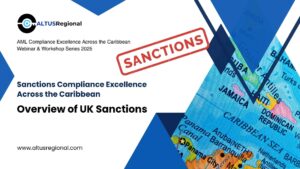
Overview of UK Sanctions
The foundation of the UK sanctions regime is the Sanctions and Anti-Money Laundering Act 2018 (SAMLA). SAMLA grants powers to the UK Government, particularly the Secretary of State for Foreign, Commonwealth and Development Affairs (FCDO) and the HM Treasury, to make regulations imposing: trade sanctions, financial sanctions, immigration restrictions and transport and shipping controls.

Research-Driven Market Entry Strategy for Barbados
Barbados offers one of the Caribbean’s most stable and forward‑looking business environments, but successful expansion requires a structured market entry strategy grounded in research, regulatory engagement, and alignment with national priorities. Companies that invest in understanding consumer behaviour, compliance obligations, and sector‑specific opportunities are best positioned to thrive.

Structured Coordination for a High-Stakes Caribbean Port Transition Project
A practice‑based look at how Altus Regional supported the coordination of a high‑stakes Caribbean port transition, distilling the lessons learned, practical approaches, and governance practices that helped maintain alignment and operational continuity during a critical period.

Food Security in the Caribbean: Addressing Post Harvest Loss Through Cold Chain Management
This article examines food security in the Caribbean, focusing on post-harvest loss, cold-chain management, and supply-chain constraints shaping food availability.
The Rising Tide of the Caribbean Blue Economy
Caribbean blue economy investment is reshaping regional development, with opportunities emerging in coastal transport, fisheries, marine tourism, climate resilience, and ocean innovation. For CARICOM nationals, the Right of Establishment offers a structured pathway to enter these markets, build enterprises, and participate in one of the region’s fastest growing economic frontiers.
Research-Driven Market Entry Strategy for Barbados
Barbados offers one of the Caribbean’s most stable and forward‑looking business environments, but successful expansion requires a structured market entry strategy grounded in research, regulatory engagement, and alignment with national priorities. Companies that invest in understanding consumer behaviour, compliance obligations, and sector‑specific opportunities are best positioned to thrive.
Structured Coordination for a High-Stakes Caribbean Port Transition Project
A practice‑based look at how Altus Regional supported the coordination of a high‑stakes Caribbean port transition, distilling the lessons learned, practical approaches, and governance practices that helped maintain alignment and operational continuity during a critical period.
Proposed Travel Ban on Five Caribbean Nations
Proposed Travel Ban poses far-reaching implications for five Caribbean nations with potentially devastating impacts on tourism, trade, regional stability

CCJ Practice Direction on Use of GenAI Tools in Court Proceedings
Analysis of the Caribbean Court of Justice (CCJ) Practice Direction on the Use of Generative Artificial Intelligence (GenAI) Tools in Court Proceedings.